Monday, February 28, 2022

Evidence of God's Love

I have nothing new to add to what anyone else is saying. Like most of my friends, I watch the headlines, scroll past pictures in my newsfeed, and just don't know what to do besides pray. I'v never been to Ukraine, but I have people there whom I love. Several of her children have passed through my classroom or fallen asleep in my arms as I babysat. When I tell the story of seeing the Northern Lights from an airplane over the Atlantic, I usually tell them how the two Ukrainian kids in the seat next to me followed me to the galley window while their parents slept - I had to lift up the little girl to help her see - and despite our language barrier, we enjoyed that most beautiful phenomenon together. 

Then there are all the people whom I love in Russia. Several of her children have also passed through my classroom, laughed with me sipping tea on my couch, patiently taught me the Cyrillic alphabet before I moved to Kazakhstan, and generally helped me appreciate the beauty to be found in that massive country. As a 10-year-old girl, I remember staring up at the colorful walls of the Winter Palace and belting out Anastasia songs as we crossed the Neva river. If it hadn't been for Covid, I would've gotten to revisit those museums with a new appreciation in the Spring of 2020, and now I wonder if I ever will.

I'm angry and grieved and disheartened and struggling to find my own stance. The Ukrainian people deserve to be the deciders of their own government and freedoms. Scripture is clear that you cannot walk all over victims because he will fight on their behalf. Yet, I also know what it's like to love the aggressor. Growing up in a country whose heritage was not only being on the losing side of both world wars, but also to be the birthplace of both men who started them, I wrestled with the question of why God would ever want to extend salvation to an Austrian. It was through my own deep-rooted passion for the people that God convinced me he still had love for these people. So, even though I hurt, I stand convinced that He loves Ukrainians and Russians because he has put a love for both into believers everywhere. May my own love grow.

"The world is indeed full of peril, and in it there are many dark places; but still there is much that is fair, and though in all lands love is now mingled with grief, it grows perhaps the greater" - J.R.R. Tolkien
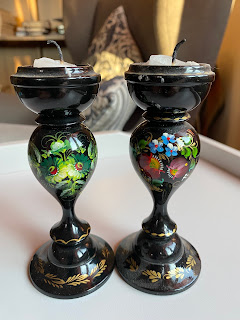
a gift from a Ukrainian colleague

Tuesday, February 15, 2022

In the Light


I walked into the room and had to laugh. There, on the table, were my tulips - which I had just arranged that morning and fluffed to look full and bouquet-like - all leaning hard to the left where the sun was pouring in the window. They looked like they were simply starved for the light. Which is probably not that surprising in the winter months of north-west Europe. Their colors also shone all the more luminously and stunning, with their yellow and orange hues, the petals almost transparent.

The High School Play opens in 2 days, and I’m in love (yet again) with the cast, the crew, and the overall production. From my “perch” backstage I get to prepare the various props, pin flowers to lapels, and give encouraging fist bumps before reminding students to remove their masks and sweep out onto the stage with volume. Then I peer through the flats and smile as the characters from the script grow transparent, and the students I love shine luminously and stunning, complete with their grayed hair, self-grown mustaches, and cucumber sandwiches. 

And then I wonder what I look like in the light. My Bible study is deep into 1 John right now, and these verses from Week 1 are still rattling in my mind: "God is light. ... If we claim to have fellowship with him and yet walk in the darkness, we lie and do not live out the truth. But if we are living in the light, as God is in the light, then we have fellowship with each other, and the blood of Jesus, his Son, cleanses us from all sin" (1 John 1: 5b, 7). I don't want to be a liar, comfortable with my facade, because if I live like that, I will continually avoid the light for fear of being exposed. I want to be like my flowers, transparent for the true light to shine through me! I guess that is only possible if I remove my mask of outward behavior and keep leaning into and craving the true light.


Monday, January 31, 2022

A Good Day in Middle School

 People often ask me why I like teaching Middle Schoolers, and beyond my standard answers of "they're so much fun" or a lengthier explanation of how they still have enthusiasm for games but can finally think beyond the concrete, I like to give examples of the kinds of lessons that bring me joy. Such as the one last Friday.

My 8th grade History class is currently in the unit on the early Americas. So far we have covered the Olmec and Zapotec (with hints of the Maya and Aztec to come), and one of the earliest, consistent archaeological findings we have from all four of these cultures is the Mesoamerican ballgame. If you've seen the 2000 movie The Road to El Dorado, you may remember the scene in which this game was featured. In the past, this is the Olmec/Zapotec achievement my students have found most interesting, so I decided this year to make a whole lesson out of it.

First, they spent 20 minutes completing a Webquest, in which I gave them links to a couple of sites and videos. They had to read or listen to the information and pick out the answers to 10 questions I had for them on a worksheet. Once they had finished gathering information, they spent the rest of the 20 minutes designing their personal version of the Mesoamerican ballgame. 

Next, I shared with them a version I came up with and brought them out into the hallway where I had set up 2 hula hoops and a rubber ball. In teams of 3, they had 30 seconds to try to score as many points as possible without using their hands or forearms. Honestly, I had no idea how it would go, especially as these particular 8th graders have a reputation of being incredibly competitive. But we had a blast! They cheered for one another, and of course celebrated every one of their own goals.

Following those 15 minutes of play, we returned to the classroom and ended with a discussion on the harsher topic of the Mesoamerican ballgame - whether players were actually sacrificed after a game. And whether those sacrificed players were the losing or the winning team. At one point, when I asked for arguments why some historians believe it could be the winners who were sacrificed, a student raised the idea that sacrifices should be perfect, blameless, the best anyone could offer. Another student chimed in, "Like Jesus was." I practically shouted, "Ooh, yes! Let's talk about THAT for a moment." So we did. And while we could all agree that human sacrifice was a horrendous practice, I think they left the lesson with a slighter higher appreciation for what Jesus accomplished, the most perfect and complete sacrifice in history.

I love Middle School.

Saturday, January 15, 2022

Memories of KAZ


The car was barreling down the two-lane highway, mostly in the left lane passing trucks and other taxis heading for the border. I distinctly remember feeling the lack of a seat belt hugging my body and using my hand to brace myself on the back of the driver’s seat, knowing full well that it wouldn’t save me or my friend Jamie from being crushed by the full weight of the vehicle when we crashed. I was imagining my mangled body out among the poppy fields when Jamie nudged my shoulder. “He’s taking a picture of the speedometer now; we’re over 200 km/h.” My prayer life doubled. Honestly, I don’t know if I’ve ever exited a vehicle as quickly as I did that taxi when we arrived at our destination, Jamie hot on my heels.

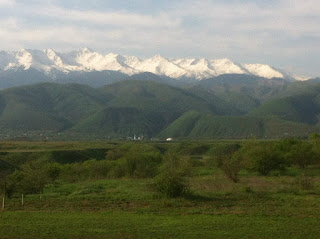
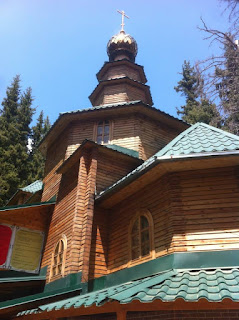
That wasn’t the only adventure I had with her in our overlapping three months in my favorite Central Asian country. We went hiking in the gorgeous Tien Shan mountains with the destination being a wooden Orthodox monastic site. We had to carry skirts with us to pull over our hiking shorts when we got close so that they’d let us in to view the building. But what was far more interesting was the character we met in the middle of nowhere who has been building himself a bonafide castle for the past two decades and thinks he is about ⅔ of the way there. He gave us a proud tour while we followed the stench of his cigarettes from one dark room to the next, his personal lair decorated with pictures of a certain former Soviet despot. 

Of course, I was really in the country to volunteer at a partner school and teach a couple classes, thus lightening the load of some overworked colleagues at that point in the year. One of those classes was 8th grade Geography. In an effort to broaden young minds and help them think beyond their borders, I assigned a country report that had to be given orally in class along with pictures and details about culture, maybe even food. Sweet Darla (name changed to protect the innocent) chose Lebanon, and I’ll never forget in her presentation when she got to the food portion and announced that she would not be subjecting us to their disgusting food. I was a bit confused as I personally adore Middle Eastern delicacies. She quickly put up a picture of hummus on the screen. “This mash,” she said pointing at it and leaning away, “is made from chicken pee.” I generally try very hard never to laugh at students, but the guffaw was across my lips before I could stop it. “I think you mean chickpeas,” I said with as straight of a face as possible; “it’s a type of bean.” Darla’s face scrunched in confusion. After thinking about this new information for about 2 seconds, she pressed the clicker, and we moved on to Lebanese dress.

It hurt my heart in the last week to watch streets I once traversed empty but for the trucks with men and guns, to see the President’s palace abandoned and charred, to not be able to get through to the friends I still have because power lines had been severed. I knew it as a place of free-flying eagles, of caring old mommas who helped me buy fruit when I couldn’t communicate with the seller, of students eager to clean up their communities, of goats that regularly blocked our drive home but made me laugh every time, and a country God loves very much. Well, at least that part is still true. 


Friday, December 31, 2021

Works of Art

 I received a surprise this Christmas when I flew to Colorado to be with family: my brother Andi has become an artist. Admittedly, he has only completed paint-by-number masterpieces so far, but they are stunning. The vibrant colors of the sunset or the lonely boat moored on a remote lake both make me wish I could climb into the canvas. My favorite one, however, is this one:

It could be any number of places I wish I could be at right now. The scene looks serene and peaceful, a far cry from the last couple of years we have had. I've been a part of multiple conversations of late in which someone has expressed the wish for such a calm moment away from the mayhem of fires, depression, cancer, and COVID. But I think sometimes we fall into the trap of thinking a remote mountain scene like the one in the picture comes about without cost.

Andi says it took him somewhere in the range of 60 hours to complete the first painting, and even this one is probably upwards of 40 hours. That is a lot of time to be bent over a piece of fabric, trying to distinguish greens and spot the right numbers. And then there's the setting itself - really, if you think about it, you're looking at cold waterfalls over jagged rocks, which are probably a result of snowstorms in harsh mountain conditions. To have been present when this scene was being formed could have meant hypothermia or worse.

Yet, isn't that precisely when hope comes in? As I reflect on 2021 and how it did not see the end of a global pandemic nor the end of my neighbor's cancer while it did hold the death of a beloved grandmother, it could be easy to see only the harshness. Hope rests in the knowledge that beautiful things are never rushed. Psalm 103 says, "The Lord knows how we are formed; he remembers that we are dust. But from everlasting to everlasting, the Lord's love is with those who fear him, and his righteousness with their children's children" (v. 13, 17). 2021 may have been awful. Or it may have been wonderful. Either way, we are being shaped by a patient God who uses time (even more than 60 hours) and all kinds of conditions, both violent and serene, to shape us into beautiful works of art. I dare to call it love.

Wednesday, December 15, 2021

Rights or Gratitude

In the past month, restrictions have tightened across Germany, so it was with finger-gnawing trepidation that we approached this last weekend of basketball games and the annual Christmas concert. Would they be cancelled last-minute? Would all that hard work never be showcased? But the school needn't have worried; while strict measures had to be observed (only vaccinated and recovered family members WITH a rapid self-test no older than 24 hours), both events were able to happen. The school posted pictures under the caption "with times like these, we are choosing to be grateful."

I've been encountering a lot of war metaphor lately with regard to a loss of rights or maintaining of freedoms. Whether it's the colleague who believes "war is happening on our rights as parents and citizens, so we need to fight back vociferously" or the sweet friend who takes the stance "war is happening on our rights as Christians, and I need to prepare myself well for the coming persecution," the sentiment is similar: don't merely stand by on the sidelines with your head in the sand.

That contrast - whether to be ready to fight or to say Thank you - has struck me again and again in these weeks. I think whichever philosophy we lean toward can end up shaping much more than just our fight for rights or our willingness to surrender them. I see it in my classroom, for instance. One student is mad at me for not giving him his seat preference or for forgetting that he needs his notes printed in a certain way to best suit his learning style; the other thanks for me for the quick turn-around of feedback on his essay or for the Christmas chocolate that he figured out came from me. In one view, every good thing needs to be claimed and comes about through the efforts of us in tandem with the Spirit; in the other every good thing is an undeserved gift from heaven that came about entirely because of God's goodness.

And I'm certain the way I just phrased that last sentence reveals which end of the scale I want to live on. The thing is, while I believe in times of righteous anger and that (at least in the West) we have the privilege of being granted many rights which we shouldn't just hand over, I find the "gratitude" stance to be more Biblical. James 1:17 says "every good gift and every perfect gift is from above, coming down from the Father of lights." In 1 Cor 8-10, Paul speaks of a willingness to lay aside rights for the sake of the gospel. E.g. "Nevertheless, we have not made use of this right, but we endure anything rather than put an obstacle in the way of the gospel of Christ" (9:12). He speaks of a willingness to be wronged if it means the gospel can advance, and of course I can't help but see the image of the bloodied Savior on the cross undergoing a total loss of rights because he could see the bigger picture.

Naturally, I can find verses to support the "war" stance as well. Galatians 5:1 says "For freedom Christ has set us free; stand firm therefore, and do not submit again to a yoke of slavery." And of course all of Ephesians 6 supports the imagery that we are engaged in a battle. Here's the thing though: the war that Scripture shows us fighting is never about preservation of our rights. It depicts our struggle being against "the spiritual forces of evil in the heavenly places." It's a war over souls! And for those souls that already belong to God, it's a war on that relationship with the Father, an attempt to remove our joy of salvation or trust in his sovereignty. 

I have zero doubt that my friends who are living in the war narrative are strong believers. They love Jesus with their whole hearts and daily seek his face in prayer, probably more consistently than I do. There is so much I can and should learn from them, and I want to listen diligently. For myself, however, I can think of no greater weapon against the enemy than to respond in gratitude. As demonstrated in my students, gratitude fosters joy, an open relationship with others, and an attitude in line with Christ, who made the ultimate sacrifice of rights. "For the joy set before him" (Heb 12:2), "he did not count equality with God a thing to be grasped, but emptied himself, by taking the form of a servant. ... He humbled himself by becoming obedient to the point of death, even death on a cross" (Phil 2:6-8). I want to be like HIM: fighting the war in sacrifice and joy.

Tuesday, November 30, 2021

Vorfreude

 It's no secret to anyone who knows me even a little bit that I love Christmas. I mean LOVE. Truly, I enjoy (almost) all parts of it from the music to the lights to the food to the candles to Advent to chocolate to snow to trees to presents to movies to so much more. I've always attributed this adoration of the holiday to my Papa, who seems to have picked it up from his Mom, my Nana. The same Nana who entered glory on November 19.

There was an idiom I grew up with in Austria: "Vorfreude ist die schönste Freude." Translated, it loosely means that the joy that comes with anticipation is the best kind of joy. To that I say yes and no. In many ways, I get more joy out of the Advent season leading up to the 24th than I do the morning of the 25th when all that's left are presents. The anticipation of my coffee this morning was better than the actual cup of remnant grounds. So yes, Vorfreude can often be more beautiful than the actual event. On the other hand, I strongly believe it is still the thing itself which you're looking forward to that gives the Vorfreude any value at all. When I was on the Camino in 2018 (a month-long pilgrimage trail in Spain), many people would say how they wished we'd never arrive in Santiago because "the journey is the true goal." But without Santiago, without an actual goal or finish line, the pilgrimage was just a long hike. If there was no Christmas marking the birth of the Savior at the end of Advent, all that anticipatory joy would be pointless. 

When I think about it from Jesus' perspective, his birth was just the start of a 30-something-year-long odyssey to the cross. Hebrews 12 tells us it was "for the joy set before him" that he endured the cross, and I have to wonder what his joy was anticipating. His birth and life seem to be merely the Vorfreude part, but how in the world can there be joy in horrendous suffering?

My beautiful Nana worked hard for a pain-free, instant-gratification kind of life. She didn't like to wait for things to happen, and she freely admitted it. There was a small sign in her kitchen that declared how she'd been absent the day God handed out patience. But when it came to Christmas, somehow she was able to take delight in the waiting. Her eyes sparkled whenever someone discovered that her little automated Santa Claus could read stories. The light-up reindeer on her balcony made her smile every time she noticed it. Really, the sooner all the decorations could be up, the better, even if it made the wait longer. It heightened the Vorfreude in her heart.

I don't think Jesus took delight in the suffering itself, but I do trust that he fully knew its worth, not just in saving me from my sins, but in the grander vision of God's story being fulfilled. "The joy set before him" had to be looking forward to that day when all things will be restored to their true beauty and ultimate good, when God would be worshiped as he was always meant to be. Nana is getting to live that reality even now, and as I wait to join her someday, I choose to live in the Vorfreude of the Ever-Advent. 

Nana's COVID-Birthday in 2020